

For seven days my husband, my daughter and her two children (age 14 and 11), and I crisscrossed the Mediterranean Sea. We walked on the red carpet in Cannes, admired the night view of Palma de Mallorca, visited a turtle sanctuary in Ajaccio, tasted freshly made pesto in Genova, marveled at the still leaning tower of Pisa, and learned basic steps of Flamenco in Barcelona (FYI, the most important element of it is passion!) . Our cruise ended near Rome, where we stayed for several more days.
Rome was hot, humid, and overrun with tourists. Still, I reserved excursions there, too — a tour of the city, the Colosseum, and the Roman Forum. The Vatican was our last organized destination and I was looking forward to it.
“Tomorrow we are going to the Vatican,” I said to my family the night before. “Don’t forget to cover your knees and shoulders.”
“OK,” My daughter and my husband said in unison, while my grandchildren looked at me gloomily.
Having done a lot of sightseeing already, all they wanted to do for the rest of their vacation was “nothing,” and going to the Vatican wasn’t that.
“I can’t cover my knees.” My grandson said. “All I have is shorts.”
The thing about my grandson is that when he doesn’t feel like doing something but doesn’t want to admit that, he comes up with a variety of dubious excuses. Once in London (my daughter’s family lives in England), when I wanted to take him to a public library, he said, looking at me very sincerely:
“In our country, Grandma, they don’t allow children to public libraries.”
That was such an obvious fabrication that I burst into laughter. A librarian myself, I knew that although the case can be made that the Brits like their dogs more than they like their children, they surely build public libraries with children in mind.
“You’ll be OK,” my daughter said to her son. “I have your track pants.”
Here my granddaughter chimed in.
“My ankle hurts,” she said. (She was jumping all over the rented apartment five minutes earlier).
Yet, to her utter disappointment, I reached into my extensive first aid kit and pulled out a muscle relaxer, so a visit to the Vatican became inevitable.

“Your tickets don’t include any museums.” Our tour guide said, looking at our reservation, and my grandchildren’s faces lit up, while their mother’s expression soured.
“What does that mean? I said. “Are you saying that we won’t be able to see the Sistine Chapel?!
“That’s right. Unless you buy additional tickets.”
“Sure,” my husband muttered under his breath. “Let’s fleece the tourists.”
Yet we paid extra and — with 30 other sightseers – headed to our destination.
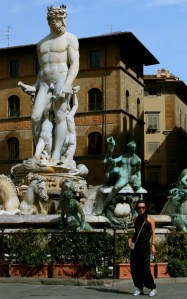
At first, the tour guide showed us around the Vatican’s grounds, and then she herded us to the additionally-paid-for museums. Of course, these were not the kind of museums I was used to — with a little bit of this and a little bit of that. These were ostentatious displays of unqualified power and wealth: gold-leaf ceilings, sumptuous decorations, luxurious carriages and pope-mobiles and, of course, famous paintings and sculptures. It was overwhelming and I fully expected my husband to comment on that or to say something inappropriate. Like the time when we were in Florence, walking around Michelangelo’s statue of David, and our tour guide said, “Does anybody see anything unusual about this sculpture?”
“He’s not circumcised,” My husband said immediately.
At that point, I quickly withdrew my hand from his and pretended that I had never seen him before, while our female guide raised her eyebrows and — not  waiting for my husband’s other insights — quickly informed the group that one of David’s legs is shorter than the other, and if he were standing up straight, we would clearly see it.
This is time, thought, a body part comment came out of the mouth of my 14-year-old grandson.
“Why did they tell us to cover our knees and shoulders?” He said looking around. “There are naked pictures all over!”
That was a very good question, but while I tried to come up with an appropriate answer, the dense crowd of visitors picked us up, pushed us through several galleries and flights of stairs, and deposited us into the Vatican’s Jewel – the Sistine Chapel.
With every inch of its surface covered with frescoes, the Chapel did look like a jewel box — or rather a jewel box filled with ants, as the visitors stood there shoulder to shoulder. My pulse quickening with anticipation, I lifted my gaze to the ceiling, fully expecting to be struck by another Michelangelo masterpiece — “The Creation of Adam.” Yet from where we entered, the famous fresco appeared backwards and I couldn’t make much sense of it. I spent some time craning my neck and twisting my body, so I could see both God and Adam the way I was used to from observing numerous reproductions, but the collective noise and heat emanating from the crowd made me feel lightheaded and I switched my attention to the walls.
 Unfortunately, the number of people pressing on me from all sides did not allow for much maneuvering. Besides, to my horror, I suddenly realized that not only did I lose sight of our tour guide, but I also lost sight of my daughter and, worse, my grandchildren! The only familiar figure I could spot in the distance was my husband’s.
The loss of my daughter in a strange city was somewhat distressing but clearly, I wasn’t in a position to save every member of my family. Therefore, I stopped looking at the frescoes and began scanning the crowd for the kids. Thank goodness! They were only twenty yards away, so I desperately pushed my way through the overheated bodies, grabbed my granddaughter’s hand with one hand and my grandson’s with the other and pulled them to the exit, toward the pennant carried by our tour guide, which loomed far ahead.
Before we exited the chapel, I glanced at the ceiling for the last time. From this direction both God and Adam looked right, and feeling relieved that I finally solved the puzzle of the creation and my grandchildren were safely in my hands, I left the building.

On our last evening in Rome my husband and I went to the Trevi Fountain. The night was starless, and by the time we reached the famous fountain, set against a baroque palazzo and brightly lit from all sides, it looked like a turquoise oasis in the dark desert of the night. People crowded all around it — talking, taking selfies, or just enjoying the view. So many people, in fact, that we couldn’t get close to the sparkling water — even less to toss a coin without landing it on someone’s head. Instead, we kissed. And it was a nice moment.
When we turned to leave, I noticed a young couple with two little girls just behind us. The man looked Middle-Eastern and the woman wore a headscarf. They, too, were trying to take a selfie, but the girls, who were too young to recognize the uniqueness of the moment, kept twisting and turning, making it difficult for their parents.
Had I met that family somewhere else, I would never have approach them. Had I met that man in any other crowded place, I would have put a distance between us. Yet here, by this fairytale fountain that spoke of romance, hope and goodwill, I looked at the pretty woman and the cute girls, and said:
“Would you like me to take a photo of you?”
They did.
I took several pictures, handed them their phone, and we left.
“Too bad we couldn’t toss a coin,” I said to my husband on our way back.
“Do you want to return to Rome?” He said.
“Sure …” I started. But then I stopped.
The one way I would enjoy that — I realized — would be returning here all together, hopefully when my grandchildren are older and can appreciate it better. As for me, my happiness does not depend on this city or this fountain. In fact, it doesn’t depend on any patch of earth. For me, a Jewish Russian immigrant to America who lost her roots a long time ago, whose parents passed away, and whose daughter no longer lives in the same country, happiness is defined by being needed, being able to help and also being able to create memories that will live after I’m gone.
It also depends on relationships – between me and my family, among my friends, and, ultimately, among all of us humans — no matter where we came from or where we’ll go next. Or, to put it simply, on everybody following the golden rule: “Do unto others as you would have them do unto you”.

 At our last Staff Day, I received a certificate marking my 25 years with the same library. My first reaction was, “OMG, I’ve worked here longer than I did in Russia!” My second thought was, “How old does that make me?!” (A silly reaction: it’s not as if I hadn’t noticed how much I have aged!). And my third thought was, “Things have definitely changed since I came to this country…”
 While librarians are not seen as glamorous creatures but rather as homely women of an uncertain age who wear square glasses, working at the library gave me a chance to learn about my new country. It also gave me a chance to work with like-minded people in an environment where camaraderie is valued above competition and where knowledge is more important than showing off.



 I am not an adventurous person. I have never been on safari or even to Alaska. Despite the fact that I immigrated to America from Russia, I do not like changes. Yet, moving beyond the city limits was my idea.
 Those who’ve been following me for a while may have noticed that I have another blog, too – Svetlana’s Photography. (Don’t take me wrong. I have no illusion about my ability as a photographer. I just enjoy taking pictures:). Here’s how it works. Every week, WordPress announces a theme, and people like me (as well as some professional photographers) post their photos to illustrate it. The theme for this week is “Treasure,” and the example we’re given is a heart-shaped stone, a keepsake that the photographer has kept in her possession for 25 years and three house moves. This, of course, made me think about my keepsakes, but I quickly realized that I no longer have them in my life, and I want to tell you to why.
 even posting something on YouTube.
 Of course, the way my mind works, I read a thoughtful essay about which is more important, the forest or the trees, that starts with “The first thing I saw when I looked out my window this morning was …,” and I immediately feel like saying, “Let me tell you what I saw when I looked out my window this morning! Deer eating my flowers! And do you know that they’ve already destroyed our apple trees, too?”
 photographers’ blogs. Why? Because I love photography. I didn’t always feel this way. In fact, I used to be one of those people who takes pictures of members of her family in front of world-renowned masterpieces, like Notre Dame, Rodin’s The Thinker, or the Mona Lisa (just kidding, they don’t allow flash photography in the Louvre :)). That way my friends will recognize what well-traveled people we are.
 Yet for a long time I ignored his opinion, until, six years ago, for our anniversary, my husband gave me a nice camera and, voilá, just like that, I got converted into a true photography fan. This doesn’t mean that I became a good photographer myself (I wish I did!), but I’m still trying :).
 In any case, one of the photographers I’ve been following on WordPress.com is
  In the summer of 2009 my husband and I were visiting Tate Modern, a modern art gallery in London, UK. It was our second hour of being there, so our pace began to slow down and our perception of modern art began to blur. We were already on level 4, when I stopped in front of an object which looked like an air vent, with a sign above that read “Acrylic Composition In Gray #6.”
 Several month ago, my husband’s aunt died, and we drove to Kentucky to attend the funeral. It was a cool but sunny November day – not sad enough for the occasion but also not too depressing to make one feel that life is meaningless. Aunt Anne would’ve liked it, too; she used to enjoy spending time outside — playing golf or going out on a pontoon boat. She was from the category about which people say, “they don’t make them like that anymore:” tall, active, with a decisive expression and an equally decisive mind – a piece of which she never hesitated to share with you. She was also a long-standing Democrat (who knew there are Democrats in Kentucky?!), and in fact, she voted by absentee ballot from her hospital bed several days before her death.
 It was our third weekend in a row to go cross-country skiing! This time, we decided to drive to Eagle Bluffs, a state conservation area about 10 miles away from our home. First of all, the snow there would be untouched, and also, just before the storm, we had seen white pelicans there.


 and I find white pelicans — so clumsy and weird-looking
  The pelicans swam aimlessly around the pond, back and forth. Every so often, they dived, so that all we could see was their

 learn as long as you live.'”

 Missouri are bad and those in Colorado are all great. When we were learning downhill skiing in Steamboat Springs, CO, we met another unpredictable skier. By the way, what’s wrong with the English language? Why do we say “downhill skiing”? Did anybody ever ski uphill? Another vivid example of peculiarities of English is the expression “horseback riding.” What do we need the “horseback” for? What other part of the horse would you ride on?
 Going back to the snow, it is impossible to break completely from your past. No matter how many years go by, your past still haunts you — with smells of food your mother used to cook for you, with flowers you enjoyed in your youth, or, as it is in my case, with snow. Not because I regret leaving my home country. I never do, and I never have any nostalgia for it. And yet, there are some memories that make my heart ache: lullabies I heard as a child, a large


 Writing With an Accent
