
Mark Twain and I


Before I read Sholem Aleichem, I read Mark Twain.  I was eight years old then, and I read it in Russian.  I didn’t know that Mark Twain was a famous American humorist, and in fact, I didn’t even know what humor was – until one day I opened that book and read:

“Tom!”

No answer.

“Tom!”

No answer.

“What’s gone with that boy, I wonder?  You Tom!”

And even as I type these lines, I smile thinking about the many adventures of Tom Saywer and Huckleberry Finn, who taught me, among other things, that children, too, can be free spirited and enterprising.

My next brush with Mark Twain took place when I turned 39, shortly after we left Moscow for Vienna, Austria.  We didn’t really choose Vienna.  It was chosen for us by the Hebrew Immigrant Aide Society (HIAS) that helps the world’s Jewry to resettle.  There must have been thousands of Russian immigrants there already – some waiting for permission to stay in Europe, some to go to Australia and New Zealand, and many more to enter the United States.

My family arrived in Vienna from snowy and aloof Moscow at the end of February.  Somebody met us, dazed and disoriented, at the airport, and drove us to the place that HIAS rented for the waves of new Russian immigrants.  There was no snow anywhere, the air was filled with early spring dampness and uncertainty, and the gray sky was reflected in the windows of residential buildings and shopping malls.  The city was beautiful, though, with soaring cathedrals, imposing buildings, and museums, spoiled only by numerous dachshunds mincing on their short legs next to their orderly owners along the city streets — the same streets that, in 1938, saw the proudly marching columns of Nazis and the terrified crowds of Jews, who were driven from their homes to, first, clean Vienna’s pavement with forks, spoons, and even their tongues, and, later, transported to the Dachau concentration camp.  Of course, we were not desperate like them, but you could not help wondering about the ironies and unpredictability of life.

We stayed there for four months, which wasn’t too bad for a family with no friends or relatives to sponsor its move to America (and you had to have a sponsor to do that), and whose only hope was that HIAS would find somebody willing to sponsor us.  It was a strange, shadow-like existence.  We were free at last, or, maybe, in a free fall — only time would tell which one it would be.  If we had died there, the city wouldn’t have noticed.  For one thing, nobody knew us there.  For another, no Russian immigrant was allowed to work – at least not legally, and the only source of income we had was the little money that HIAS gave us each month and even the smaller amount we earned ourselves by selling  our camera, cotton bedding, and matrioshkis — as well as other Russian souvenirs –at the flea market.  And yet, life went on and my daughter even attended school, or what passed for school in that ephemeral existence: a room in the Jewish Resettlement Center, where children of all ages studied together with the teachers who were also in transit — one day the school had a math teacher and the next day she was gone.

And then, one day, somebody called from the American Embassy:  “Congratulations!  You’ve received an entrance permit.  You’re going to Columbia, Missouri.”  “Where is it?”  “Between St. Louis and Kansas City.”

We hung up the phone and ran to the nearest library.  There we found a map of the United States, in the middle of which we spotted a tiny dot for St. Louis and, close to it, another one for Kansas City.  Columbia was nowhere on the map, yet the word “Missouri” rang familiar.  Wasn’t that the birthplace of Mark Twain?  I grabbed a large dictionary.  Yes, Samuel Clemens was born and raised in Missouri, and since he went on to become a major American writer, we couldn’t go wrong there, either.

Fast-forward another ten years.  This time, I am on vacation in dry and beautiful Santa Fe.  We — my American husband, my daughter and her future husband, and I — are walking along the streets edged by blue and yellow adobe houses, admiring their bright colors and front yards landscaped with rocks and cactuses, and stopping at every art gallery.  At one intersection, I turn around the corner and, suddenly, come nose to nose with Mark Twain.  The great man sits on a bench surrounded by bronze horses, statues of children, and other art objects.  His left hand rests on the back of the bench, and his right hand holds an open book.  What in the world is he doing in New Mexico of all places?

Well, I never found the answer to that.  But that day in Santa Fe, I found an answer to something much more important to me.  Some time earlier, I began to venture into writing.  Yet to my surprise, it turned out to be very hard, and not only because English was my second language (although that was a big part of it!).  There was something else missing in my prose, vital and elusive.  I spent hours on my computer.  I poured my soul into every phrase (I came from the Russian tradition where “soul” was very important!), yet everything came out dead and full of self-pity.  What was wrong?  But as I stared at the familiar face framed with a mass of wavy bronze hair, it suddenly came to me.  The thing I was missing was humor.  Life has many facets, and humor is one of them.  It enlivens our life when we perform everyday chores, and it makes our life bearable when we suffer.

It would be wrong of me to say that the sudden encounter with the statue of Mark Twain miraculously improved my writing (in fact, it would take me another five years to publish my first piece), but it definitely helped me find my “voice.”

P.S.  Before we left the gallery, I asked my husband to sit next to Mark Twain and took a picture of both of them together.  Here they are – two great men in my life!
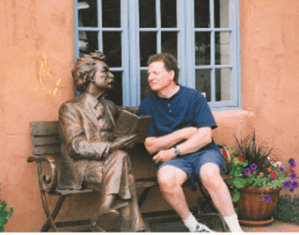
Samuel Langhorne Clemens was born on November 30, 1835, Florida, Missouri.  Happy Birthday, Samuel Clemens!

Please click “like” if you like my picture :).  Also, tell me about your “role models,” would you?

 P.P.S. This is a long post, but if you’re still reading, I’ll confess to you that, originally, I wrote:  “Life has many faucets, and humor is one of them,” which my husband had a good laugh about.  Now, if you’re chuckling, too, I must tell you, humor—like God—works in a miraculous way! 
©Writing With an Accent. All Rights Reserved

What Was That Holiday in November?


Dear friends,

This is a story I wrote some time ago for the Christian Science Monitor.”  I hope you like it 🙂

“I’m not celebrating Thanksgiving.”

“Why?”

“It’s their holiday. I don’t know what it’s about. Besides, what’s there to celebrate?”

I looked at the middle-aged Russian woman. She had settled in our town recently, and I hardly knew her. Yet, I knew her very well, for, reflected in her tired eyes, I saw myself many Thanksgivings ago.

Every time I heard the phone ring, I felt like dashing to the bedroom, covering my head with a pillow, and pretending that I was still in Moscow. 

The honeymoon phase of immigration had passed – when the never-before-seen abundance of food sent me into a trance, and aisles of Wal-Mart clothes thrilled me as much as a field trip to Lenin’s Mausoleum. But a new reality had set in – a nagging fear that I’d never make it in America and that bringing my young daughter here was the most irresponsible thing I had ever done.

The phone kept ringing. I picked it up, muttered, “I don’t speak English,” and immediately hung up. At night, it rang again, and my daughter, who knew some English, answered it.

“The Hermanns are inviting us over for Thanksgiving dinner,” she translated.

“Thanksgiving? What’s that?”

“A holiday.”

“What’s it about?”

“I’m not sure.”

Americans had invited us to meals before, and I appreciated their effort, although not the food. One family cooked us a Mexican dinner. The only thing I knew about Mexican culture was that they wore sombreros. As for the food, I had no idea what it consisted of, so when I bit into a jalapeño pepper, I was surprised and unprepared for the spicy aftereffect. The alarmed hosts rushed to me with a glass of ice water, the only drink they had at that meal. Where I came from, nobody served tap water to guests.

Another time, we were invited to a Chinese restaurant. I wasn’t familiar with Chinese food either. Also, we weren’t given knives and forks, and I couldn’t eat with the chopsticks they gave me. So I left that feast hungry.

On Thanksgiving, I timidly opened the door of a two-story brick house from which came wonderful aromas of food. What were we celebrating?

Back in Russia, we celebrated the anniversary of the Great Socialist Revolution in the fall. A large military parade took place in Moscow’s Red Square. Rocket launchers, nuclear missiles, and tanks shook the square’s cobblestones, thousands of troops goose-stepped, and “volunteer” factory workers paraded past Lenin’s red-granite mausoleum, where high government officials waved and smiled to shouts of “Slava!” (glory) from the crowd.

None of it seemed relevant now. No tanks rolled through our Midwestern town, and no military marches were heard.

Could Thanksgiving be a religious holiday? I had vague recollections of Thanksgiving prayers in the Russian Orthodox Church. Yet, there wasn’t a single onion-shaped dome in our town.

What holiday was it, then?

The house was decorated with carved pumpkins and mums. On the table rested a large brown turkey, a gravy boat, a bowl of cranberry sauce, carrots, beans, sweet potatoes, and pies.

I wasn’t used to turkeys – chickens and ducks were more common back home – but I liked the taste. I didn’t touch the cranberry sauce, though. (Who eats poultry with jam?) Sweet potatoes looked weird (aren’t potatoes supposed to be white and salty?), so I skipped them, too.

I also skipped the pumpkin pie. My mother used pumpkins to make kasha (porridge), not a dessert! There was some kasha-looking dish on the table called “dressing.” To me, “dressing” implied putting on clothes, so I didn’t try it.

When the dinner ended, I asked my daughter to inquire about Thanksgiving. “Oh, Thanksgiving started at the time of the Pilgrims. They celebrated their first harvest and good fortune. And we, like them, express gratitude for everything we have,” she was told.

I had never studied American history, and the only pilgrims I’d heard about were people traveling to holy sites in the Middle East, not in America. As for gratitude, I mentally reviewed my situation. Formerly an engineer, I now worked nights at a retirement home making minimum wage. I rented a small apartment and drove a rusty car. I had no friends, and my daughter was my only family. I couldn’t even speak English. I had little to celebrate, I thought.

Many things have happened since then. Gradually, I learned English. Later I met and married a wonderful man, and, in time, my daughter became a mother herself. My life was similar to the lives of others who came here before and after me – with work and worries, sadness and happiness.

As for Thanksgiving, it became mine, too, because who are we immigrants, if not pilgrims? Like them, we come to a place we don’t know much about. Like them, we rely on the kindness of strangers. Like them, we go through hard times. And like them, we come to appreciate our good fortune.

I looked at the Russian woman. “You’ll celebrate Thanksgiving,” I said. “You’ll see. Just remember our Russian saying: ‘Without effort, one cannot pull even a small fish from the pond.’ ”

Thanksgiving turkey by antonellomusina
©Writing With an Accent. All Rights Reserved

Choices


I hate having choices! Where I grew up (in the former Soviet Union) we usually had one choice. For everything. In fact we were happy to have that one choice, because most of the time we had none at all. For example, if you saw a line for winter boots, you wouldn’t be picky about the size they had left by the time you reached the counter. You’d try to make them fit (if nothing else, that was a good exercise in building your character), or, in the case of absolutely irreconcilable differences between your feet and the size of the boots, you’d pass them on to somebody else – a family member or a friend.  The same went for jeans, bras, and any other essentials.  Most of the time, when we saw a line, we wouldn’t even ask what it was for – we knew we needed it.

The upside of that life style was that we had no confusion.  Here in America, you can’t order a sandwich without being showered with multiple choices of ingredients, condiments, breads, etc.  And that is not to mention that at the end, the sales clerk will ask, “For here or to go?”  When I heard that for the first time, I – fresh off the plane – said, “Is there a particular place I need to go to with my sandwich?”  (Just kidding, I couldn’t have said that.  I spoke no English then :).)   I was also asked if I wanted a “bottomless cup,” which left me almost in a state of paralysis, for how could a bottomless cup hold any coffee?!

Another thing that is wrong with having several choices is that as soon as you make your choice, you are responsible for the outcome of your decision. This is exactly why my husband avoids making decisions altogether: where we should go on vacation, where we should stay when we get there, etc. In fact, he doesn’t even choose the movies we see! Which means that I am the one who makes all these decisions and who suffers the consequences (well, I usually let him know that I’m suffering, so he’s not completely oblivious).

And you know what his indecision does to me? I’ve become really and truly neurotic. When a waitress walks me to a table, I am never happy with that table, so I ask her if we could sit at a different table – which inevitably turns out to be even worse than the first one, and I have to start all over from the beginning. Actually, my problems start even before my husband and I walk into the restaurant – at the moment when he asks me where I’d like to go for dinner.  This usually happens on a Friday night – when my decision-making ability is depleted by working 5 days in the library and dealing with whatever that may entail. (Did I tell you that the last time I was the librarian-in-charge somebody jumped off the second floor balcony, and I had to call the police and the ambulance, and then talk to three traumatized bystanders who tried to prevent the guy from falling and killing himself? — Don’t worry. The jumper landed on his feet.) In any case, the last thing I want to do on Friday night is to make another decision. So, I say, where do you want to go? And my husband says, where do you want to go? And after several rounds of that, he finally names a place – which is never the one I want to go to. You’d think that after 15 years together he’d know better! Yet he never does. Even worse, as soon as I convey that fact to him, he says, “Why didn’t you tell me this before?” And I say, “Because before I didn’t know that I wouldn’t like it!”

Jokes aside, we make choices every day, and even the smallest of them change us in some ways – sometimes for the better, sometimes for the worse, and at other times both. Yet we rarely know in advance which one it will be. The most important choice I’ve ever made was to leave my home country. Was it a good choice?  Yes, it was, and I am glad to have made it. But I am separated from my sister and my parents, who now live in Israel, and my daughter decided to spread our family even further – she, as well as my two adorable grandchildren, lives in London. These are the consequences of my decision. Did I see them coming? Of course, not. As Kahlil Gibran said, “We choose our joys and sorrows long before we experience them.”

Going back to choices, a week ago, we all made our choice. Let’s hope it is a good one!

P.S. Do share your stories with me, would you?


©Writing With an Accent. All Rights Reserved

Elections 2012


Thank you everybody who read/liked/commented on my Halloween story!  It’s so encouraging (and inspiring) for a writer to be appreciated.  You, guys, are great!  Now, I was not going to publish anything until November 15, but since we’re all waiting for the results of this election, I thought you may like my other older story, too.  Enjoy!  (I hope :))

Thank goodness for democracy!

I sighed. “Another sweepstakes.”

“Did you sign up for that no-call-no-mail-no-contact-under-any-circumstances list?” My husband asked.

“Yes, I did,” I said, opening the envelope.

Ms. Svetlana Grobman, you’ve been selected for a Presidential Campaign Survey.”

“It’s not a sweepstakes,” I informed my husband, wondering how my adopted country managed to survive without me during the years I lived in the Soviet Union.  The USA obviously needed me. For example, since I became an American citizen in 1995, I’ve been called for jury duty four times! I work with people who’d love to serve, but had never been called, including my mother-and father-in-law, who were seventh-generation Americans. Even my husband, now retired, has been called only once.

Similarly, when strangers telephone our house, they always ask for me, although nobody can pronounce my name. Only rarely do they want my husband with his conventional English name, Charles.

“Did anybody else receive a presidential campaign survey?” I asked my colleagues the next day. None had.

That night, I told my husband, “I have to answer that survey. It’s signed by a presidential candidate. He’s asking me to participate in the democratic process.”

“Did he also ask you for a donation?” my husband asked.

I disregarded this remark. Nobody had asked him to participate in the democratic process. Besides, he was used to democratic elections, with a choice among candidates; whereas, during my 39 years in Moscow, I never experienced such a thing.

My first Soviet election of the 1970s was a grand affair. Bravura patriotic music poured out of loudspeakers. Dressed-up people filled the sidewalks. Yet the polling place looked like my idea of purgatory – with many people going in and very few coming out. I walked inside. Several unsmiling officials crowded at the counter, busily checking voters’ passports, putting check marks by their names, and handing out ballots. Behind the counter perched an unused voting booth. The only things spoiling the bureaucratic orderliness of the voting process were the scents of seafood and noises oozing from the adjacent room, where crowds of people blocked the doorway.

“Masha, lend me some money!” I heard somebody shout.

“How much?” the invisible Masha hollered back.

Clearly, the next room was a happening place, and everybody around me thought so, too. As soon as they got their ballots, they quickly deposited their votes, and dived into the mass of bodies and tempting aromas on the other side.

While waiting to deposit my ballot, I absent-mindedly read its contents, which did not surprise anybody in the country. For every election, there was only one name on the ballot for each office, and the Soviet people were always unanimously united behind that person.

The best thing about this system was its simplicity. We weren’t bothered with phone calls or mail, we never researched our candidates (the names on the ballots rarely changed anyway), and we never had any doubt about the results – 99.9 percent of the population happily embraced their only choice.

The excitement in the next room was triggered by a buffet set up there for the election. It was covered with delicacies one wouldn’t find on any other day. Cans of caviar stood there like Kremlin turrets, packs of smoked salmon emitted mouth-watering scents, and piles of cured sausages rose like revolutionary-era barricades. In short, it was a celebration of the Soviet regime at its best.

This happened year after year, until, in the late 1980s, the Soviet economy plummeted and the assortment of election goodies dwindled. I lost my “election” enthusiasm long before that. One year, I walked into the voting booth, shut the curtain, and crossed out the only name on my ballot. The next time, I tore the ballot up. Finally, I just stopped going.

Yet, the election result was always the same – 99.9 percent approved. Actually, not voting caused me more trouble, since, inevitably, a portable ballot box appeared at my door, brought in by a grumpy bureaucrat, eager to put a check mark by my name.

My first American election took place in 1996. It was a casual affair. The polling station was in a nearby church, and the atmosphere lacked the excitement I was used to. One gray-haired volunteer checked my voter registration card, and another handed me a ballot – a document with several columns of little ovals and names. At the end, I was given an “I voted” sticker and a doughnut instead of caviar.

In recent years, I’ve voted at a school, where there are no doughnuts, coffee, or music. And yet, I do not miss the Soviet-style elections, for whatever the weaknesses of American elections, they have something I didn’t dream I’d ever see – choices.

No, I’m not naive. I know my single vote doesn’t count for much. But together with the votes of others, it has power – the collective power we pass on to our candidates, hoping that they’ll use it wisely. As for the torrent of dinnertime phone calls, campaign materials, and donation requests – I’m annoyed with them at times, but, I tell myself, “Thank goodness for democracy!” And, sometimes, I even reach for my checkbook.

©Writing With an Accent. All Rights Reserved