
 Did you notice that the older you get the more appropriate clichés seem to be? For example, “Time flies.” And it really does! Seems like we just celebrated the new year (I’m not talking about the Jewish New Year 5774, which we did celebrate recently, September 4-6), but the stores are already decorated for Christmas and people are thinking about Christmas presents. I am not in a hurry, though. I wish I could stop this feverish pace.
“It’s not even Halloween, yet!” I say – only to hear, “Halloween is for children.”
True, but I have a weak spot for it. I even wrote about my first Halloween in America in this very blog. Yet, since I have more “followers” now, I’d like to post that story again.
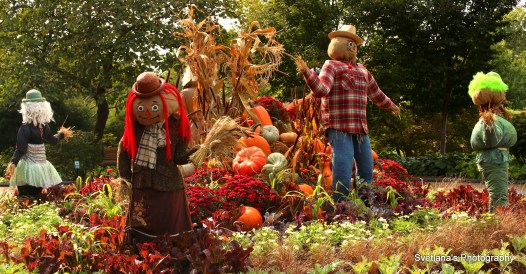
A Sweet Welcome to America
I cautiously opened the door and there they were – a smiling blue-eyed woman in worn-out jeans and a bulky sweat shirt, and a little girl dressed in a long red gown and a black star-speckled cloak. A tall peaked hat crowned her curly blond hair.
“Hi,” the woman said amicably, and her smile widened until it couldn’t get any bigger or more sincere. Her eyes seemed to fix on me conspiratorially.
“Hi,” I echoed apprehensively.
Suddenly, the girl stepped forward and blurted out something short and rhythmical. I stepped backward. She spoke English, but I had no way of deciphering her words. My only translator, my teenage daughter, was not at home.
“Do you need help?” I asked, carefully pronouncing one of the few phrases I, a former Russian engineer, had learned in the Midwestern retirement home where I currently worked as a nurse’s aide.
The shape of the woman’s mouth changed from a crescent to a straight line. The girl turned to her mother and then again to me. She gave me a demanding look and forcefully repeated her mysterious chant.
A knot of panic formed in my stomach. The visitors did not look like criminals, although you never know.
There were beggars in Moscow who went from house to  house asking for money, carrying their crying children dressed in rags. Also, Gypsies occasionally came and offered palm reading. In fact, when I was a teenager, a friend of mine had her palm read by a Gypsy who told her that she would embark on a long trip overseas in about 20 years. Of course, the last I heard of that friend, she was still in Moscow. It was I who found herself overseas anxiously gawking at two strangers.
Well, everything here in my new home was strange. The temperature fluctuated between 85 and 105 degrees F. for the first two months after we arrived in July. Accustomed to Moscow’s mild summers, we found the heat unbearable. Then, in September, we experienced our first tornado.
 Tornadoes were unheard-of back in Moscow, and, at the time, I never listened to the radio (What would be the point for me? It’s all in English). So, despite the screaming of sirens, I headed for a grocery store. It was about 1 p.m., but as soon as I got into my beat-up Buick, the sky darkened as though it was night, and the wind started wailing so ominously that only a clueless foreigner such as I would venture outside.
Fortunately, the traffic lights saved me. Blinking yellow in all directions, they confused me – a driver with only two weeks’ experience – so I turned back home. There a good-hearted neighbor dragged me into our apartment building’s basement while I tried to persuade her in my broken English that I had better things to do.
Two weeks later, the town started preparing for an earthquake, and I was seriously reconsidering the wisdom of my decision to emigrate to the United States. We had plenty of problems back in Russia, but we never had earthquakes! The disaster was expected to strike in 10 days, so people and businesses prepared for the worst – storing canned food, bottled water, and other imperishable necessities. Because we lived in a small apartment, I stocked things under the kitchen table – where they stayed for a month after the anticipated date had passed and, to my relief, no earthquake struck. And now this unexpected visit.
Slowly, I tried to close the door, but the girl’s lips started to twist and the mother burst into a long tirade in which I recognized “give” and “candy.”
 Did they want candy? I eyed the visitors and noticed a small basket in the girl’s hand – half full of candy. If this was a robbery, it was a “sweet” kind, although this might have been just the beginning. Suddenly, a warning penetrated my brain: “If you’re being robbed, never argue, just give them what they want.”
Nervously, I rushed to the pantry, snatched two bags of Hershey’s Kisses and a bag of peanut clusters, and handed everything to the robbers. This time, the girl stepped back, and the mother fanned the air with her hand in a rejecting motion.
“Candy, no?” I asked warily.
The woman gave me a look overflowing with pity and grabbed one of the bags. She tore it open, and then turned to her daughter and whispered something encouraging. Immediately, the girl’s fingers dived into the open bag and came out with three pieces of chocolate. The mother shoved the rest of the bag into my hands, smiled brightly, and said, “Welcome to this country!”
Several minutes after they left, I was still in the doorway, vacantly watching chocolates spilling from the open bag.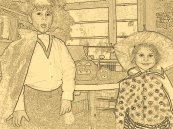
That was my first American Halloween – as new to me as garbage disposals, garage-door openers, and all the other American conveniences. Since then, Halloween has become a mark of my immigrant’s progress. On my fourth Halloween, I moved into my first house; on my seventh Halloween I got engaged to an American man; and on my 14th my grown-up daughter had her first child – my first grandson.
When little Alex is old enough, I hope we’ll go out together on Halloween night. He’ll say “trick or treat!” while I stand behind him, smiling. And if someone answers the door who knows nothing about Halloween, we, too, can say, “Welcome to this country!”
Happy Halloween!
©Svetlana Grobman. All Rights Reserved
 At the beginning was the word. Or, rather, a paragraph I read in a blog — about Scott Kelby Worldwide Photo Walk. For those who don’t know about Scott Kelby, he is a photographer and an author, whom I discovered when I was still a library selector. Don’t know what that means? Well, it used to be that librarians ordered books for their libraries — each for her selection area. Mine was the arts, and photography was included there.
 “Virazhaet to lizo chem sadyatsa on krilzo” or “He wears an expression that makes his face look like his butt.” As for my grandchildren, one of them begins rubbing his eyes with his fists and the other rolls her eyes or sticks out her tongue.
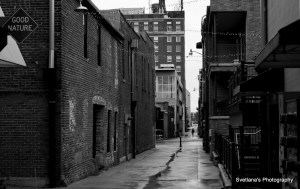 My camera will get wet. Of course, I can carry an umbrella, but how am I going to hold my camera steady with one hand? Then it occurred to me that somebody else may want to take my place but I couldn’t think of anybody. Finally, I got myself together and drove along damp and empty streets to the gathering place.
 in the middle of a small park looked somewhat misplaced. Several of them were young, several had gray hair, and all carried bulky cameras. The leader gave us his last instructions and a


 Writing With an Accent
