
Forward: an Essay in Pictures.

I don’t know about you, but when I was young, I was very smart. I also had a great vocabulary (Russian, of course) and I was going “to make a difference.” The strange thing is that now, many years later, I no longer feel very smart, the differences I make are mostly culinary (so the only person who notices them – or not — is my husband), and my English vocabulary could still use some improvement. Just today I told my husband that, due to a winter storm that struck our area the day before, two Midwestern airports had to close, leaving a lot of passengers strangled there. Naturally, I meant to say “stranded,” but despite that, my husband burst into laughter and, after he stopped laughing, said, “Don’t you hate it when that happens?!”
How and when my decline began I cannot say, since for a long time I believed that I was moving forward, the way one is supposed to.  Yet in fact, I apparently have been regressing for most of my adult life. Some of it I can blame on my Soviet past. It’s hard to keep your sanity when strangers on the street shout at you, “You dirty kike go to your Israel!” It’s even harder when, after you had finally decided to move to America, gone through an interview in the American embassy, and – lucky you! – received an entrance permit to the United States, you found out from your local authorities that you had “no right” to leave the country where everybody hates you. Talk about catch 22! It’s amazing that I escaped with most of my faculties intact!
Also, my regression might be a result of aging. For example, I used to remember everything. Now my only means of staying on top of things is my Google calendar. And if there is something that cannot be entered there – random names for one thing — I’ll never be able to come up with it. Well, this is not exactly my fault.  Some people’s names are way too complicated, like that actor’s — you know … … the one who played Abraham Lincoln … Something Month-Lewis. Besides, it’s not like I forget the name of my ex-husband. He’s name is … Well, what do I need his name for? I’m no longer married to him anyway.
Actually, the worst thing about this age related backsliding is that things and objects around you suddenly take a life on their own. For example, you take off your bra and panties and climb into your bathtub, thinking that afterwards you’ll take your stuff to the laundry. Yet by the time you shower, dry your hair, and apply night cream to your face, both the bra and the panties are nowhere to be found. You then spend the next 30 minutes turning everything in your bathroom (and your bedroom) upside down and interrogating your husband — all to no avail. But in the morning, your husband finds your panties on top of his shaving kit and your bra in his chest of drawers, and nobody seems to know how they got there.
But the way, speaking of underwear, I never drop my clothes on the floor; I have a moral conviction against that. When I watch movies where lovers, in the moment of passion, rip clothes off each other and strew them around the floor, I always feel like screaming, “Pick up your clothes! Didn’t your mother teach you anything?”
 Going back to the winter storm I mentioned at the beginning. Until recently, we had no winter at all, not even for a day. But at the end of February, a blizzard fell on us like a gigantic white pillow, smothering everything in its way and completely stopping life in our town. Even the library where I work closed – it lost both power and, most importantly, the Internet. So with nothing much to do at home, my husband and I decided to go cross-country skiing, which is not very popular around here. Actually, since we get snow once in a very blue moon, none of the winter sports is, and we must be the only household in town that owns cross-country skis.
With 10 inches of snow on the ground, we started our run from our porch 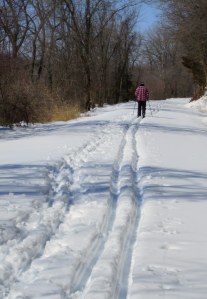 (we live some 300 yards away from a city recreation trail). For a while, we struggled to get our muscle memory back, but soon, we found our rhythm and began moving forward. It was a slow going — the snow was deep and we were the first to break its puffy surface. Yet gradually my breathing relaxed and my mind, no longer needing to supervise my feet, began wandering. I was moving faster now, enjoying the fresh snow and admiring the silky blue sky, and there it suddenly struck me. Skiing is just like life! When you’re young, your parents put you on your skis and teach you how to move, and for a while, you follow their tracks. Then, by the time you become strong yourself and leave your family behind, someone else comes along and slides beside you. And later yet, you have your children, and they begin following your tracks – until you move aside and they continue on their own. And while we, the skiers, change, the run continues, for a long time for some and for others not, but always in the same direction – forward.
©Svetlana Grobman. All Rights Reserved


 Every time winter comes around and my colleagues begin complaining about the cold, I find myself longing for snow. Not for six months, mind you, the way I experienced it in Moscow. Just for a couple of weeks or so. This, unfortunately, never happens in Mid-Missouri. Our usual pattern is this: it snows heavily for a day and the roads become slick and dangerous for driving, but as soon as the city takes care of that, the temperature rises and the snow melts.
 Missouri are bad and those in Colorado are all great. When we were learning downhill skiing in Steamboat Springs, CO, we met another unpredictable skier. By the way, what’s wrong with the English language? Why do we say “downhill skiing”? Did anybody ever ski uphill? Another vivid example of peculiarities of English is the expression “horseback riding.” What do we need the “horseback” for? What other part of the horse would you ride on?
 Writing With an Accent